Best Private Equity Courses for Breaking Into Mega Fund Private Equity

If you're interested in breaking into finance, check out our Private Equity Course and Investment Banking Course, which help thousands of candidates land top jobs every year.
The Value of Private Equity Courses
A good private equity course compresses months of trial and error into a structured plan, which matters when on-cycle recruiting can move from headhunter outreach to a signed offer in a matter of days.
If you are recruiting for a mega fund like Silver Lake, TPG, KKR, or Blackstone, the question is not whether you need to be technically sharp. It's how fast you can get there.
This guide ranks the best private equity courses for breaking into mega fund private equity, names the people behind each one, and explains what each does well. We built our own course after recruiting for the buyside ourselves, so we'll be candid about where we fit and where other options make sense.
Why Take a Private Equity Course at All?

A private equity course is a structured prep program that teaches LBO modeling, case studies, and interview technique in the order firms actually test them. You can learn all of this for free from blog posts and forum threads. The problem is sequence and signal.
Free material is scattered. You don't know which paper LBO format a fund will hand you, which technical questions are current, or how a real modeling test is scored. A course solves three specific problems:
It puts the material in order, so you build fluency instead of jumping between random topics.
It uses real case formats, so practice looks like the actual test.
It saves time, which is the scarcest resource once on-cycle kicks off.
On-cycle recruiting for mega funds has become extremely accelerated. First rounds, modeling tests, and superdays can land in a two-week window, and offers often come with short fuses. The candidates who win those offers have usually built a full LBO from scratch dozens of times before their first interview. A course is the fastest way to get those reps.
Takeaway: A course won't think for you, but it removes the guesswork about what to study and in what order.
What Mega Funds Actually Test
Before comparing courses, it helps to know what you are preparing for. Mega fund processes usually move through four stages:
Headhunter screen. A short call on your story, why private equity, and basic technicals.
First round. Behavioral questions, a deal walkthrough, and often a paper LBO done verbally in five to ten minutes.
Modeling test. A one-to-three hour Excel-based LBO built from a case packet, sometimes a take-home.
Superday. Back-to-back partner interviews, frequently with a case or investment recommendation.
The modeling test is the round that separates candidates. The best courses are built around it. Keep that in mind as you read the list: a course's quality lives or dies on how realistic its case studies and model tests are.
The Best Private Equity Courses for Breaking Into Mega Fund PE
1. Peak Frameworks Private Equity Course
Best for: candidates targeting mega funds and upper-middle-market firms in on-cycle recruiting.
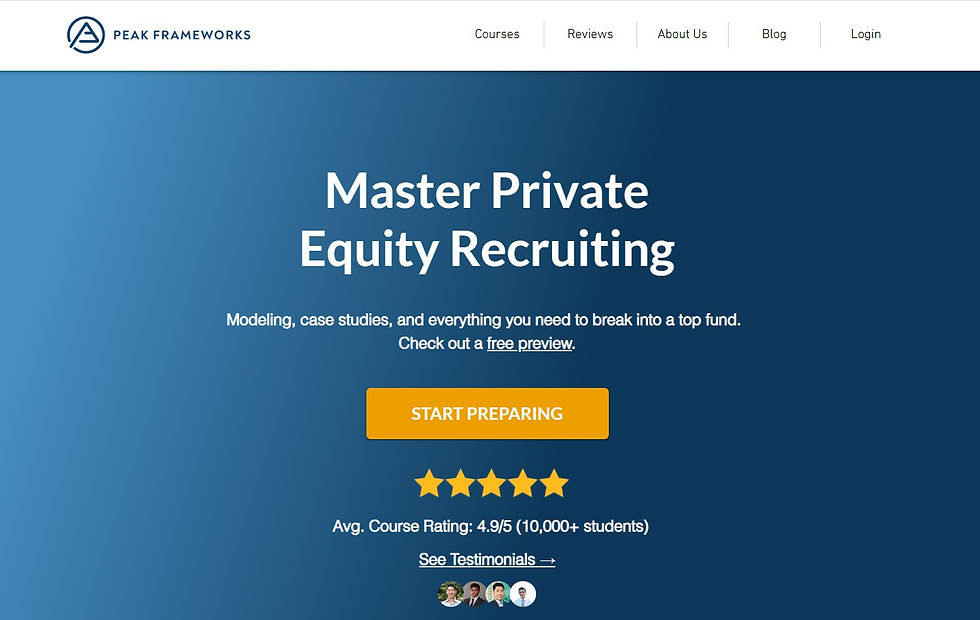
We built the Private Equity Course specifically for the on-cycle process, which is why it leans hard into recruiting rather than general finance theory. It includes over 100 video and Excel tutorials, real LBO model tests, case studies previously used by top funds, and a resume database reviewed by North American headhunters. The course carries a 4.9/5 average rating across 10,000-plus students.
The team comes from the buyside and advisory side directly. Course Director Matt Ting worked at Silver Lake Partners, Providence Equity, and Evercore. Advisors include Patrick Fong, a Vice President at TPG Capital, and Ryan Yaraghi, a Principal at Searchlight Capital Partners. That background matters for a simple reason: if you want to break into Silver Lake or TPG, learning from people who worked there gives you the actual case formats and question styles those firms use.
We are also one of the few providers to share real case studies previously used by firms, and the only one we know of that pairs them with a headhunter-reviewed resume database. Pricing runs in the $497 to $599 range depending on the package.
2. Wall Street Prep
Best for: rigorous, standardized LBO modeling fundamentals.
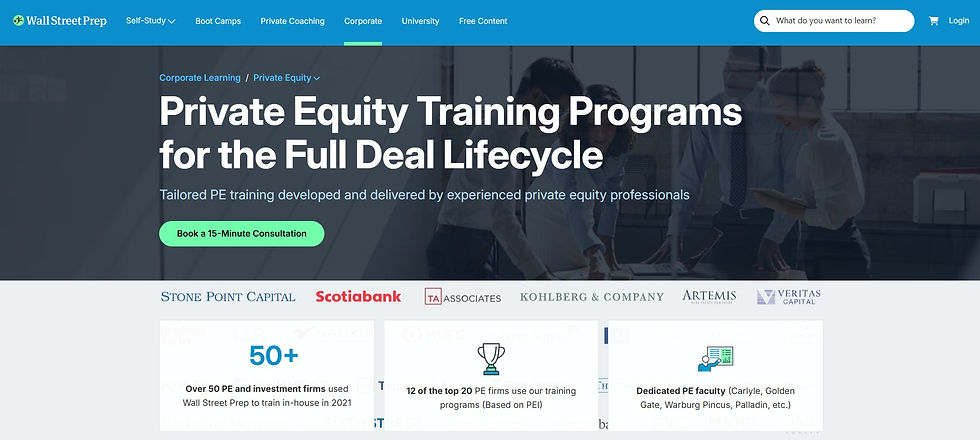
Wall Street Prep was founded in 2004 by Matan Feldman, a former investment banker. The company is the corporate-training standard at many banks and PE firms, which tells you the modeling instruction is solid. Its LBO Modeling course is built around a real transaction, the Bain Capital and Golden Gate Capital buyout of BMC.
Wall Street Prep also runs a Private Equity Certificate Program with Wharton Online, an eight-week program co-taught by Wharton faculty and PE practitioners. The certificate is a credibility signal more than a recruiting tool, so it fits candidates who want a structured credential alongside the technical reps. Expect strong mechanics and lighter recruiting-specific coverage.
3. Breaking Into Wall Street (BIWS)
Best for: deep, granular modeling practice across many case variations.
Breaking Into Wall Street was founded by Brian DeChesare, a former investment banker who also runs the Mergers & Inquisitions blog. BIWS is video-based and goes deep on mechanics, with multiple LBO case studies covering earnouts, management rollovers, and complex debt schedules. Candidates who want volume and variety in their modeling reps tend to like it.
The trade-off is breadth over recruiting specificity. BIWS teaches you to build models thoroughly, but it is less focused on the exact mega fund on-cycle process than a recruiting-first course. It also offers a 90-day money-back guarantee, which lowers the risk of trying it.
4. 10X EBITDA
Best for: PE interview coaching and a buyside instructor pedigree.
10X EBITDA is a smaller outfit run by former bankers from Goldman Sachs and investment professionals from firms like KKR, TPG, Carlyle, Warburg Pincus, D.E. Shaw, and Citadel. Approaching its 10-year anniversary in 2026, its roots are in private equity interview coaching, working one-on-one with candidates through on-cycle and off-cycle processes. The team has built a flagship interview course on the patterns they saw placing coaching clients into mega funds and upper-middle-market firms.
10X EBITDA is a good fit if you want personalized coaching and an interview-strategy angle rather than a purely self-paced modeling library. Its financial modeling course is taught by a former Goldman Sachs technology, media, and telecom (TMT) banker and leans on graphics and animation to explain the logic step by step.
How to Choose
Match the course to your gap, not to the brand name:
Need recruiting-specific prep and real fund case studies? Start with a recruiting-first course built by people who worked at the funds you are targeting.
Need to drill modeling fundamentals from zero? A standardized modeling curriculum gives you clean mechanics.
Want one-on-one interview coaching? A coaching-led provider will give you direct feedback.
Most strong candidates use one core course and supplement with targeted practice. Buying three overlapping courses is usually wasted money. Pick the one that closes your biggest gap, then drill case studies until the mechanics are automatic.
Best Private Equity Course for Breaking Into Silver Lake or TPG
For Silver Lake or TPG specifically, prioritize a course built by people who actually worked at those firms and who teach the on-cycle process directly. Both are technology-focused mega funds with fast, competitive processes, so your prep needs current case formats, not generic templates.
Our Private Equity Course is built by a team with Silver Lake and TPG experience, which is the closest match to those specific processes. If your modeling fundamentals are shaky, pair it with a standardized modeling curriculum to firm up mechanics first. The point is to practice the exact test these firms give, then repeat it until you can build an LBO from a blank sheet under time pressure.
If you want context on the firms themselves before you prep, read our overviews of Silver Lake and TPG, and our breakdown of what counts as a mega fund.
Frequently Asked Questions
Do I really need a private equity course to break into a mega fund?
No course is mandatory, but one helps you prepare faster. Everything tested in PE recruiting can be learned for free, but a course sequences the material and uses realistic case formats so you waste less time. Given how compressed on-cycle recruiting is, speed of preparation is often the deciding factor.
When should I start preparing for on-cycle recruiting?
Start as early as you can, ideally before your banking analyst program begins. On-cycle for mega funds can kick off within four to five months of starting work, and it typically takes at least a month to digest the core technical material. Building LBO fluency before the desk gets busy is the safest plan.
What is the most important skill to practice?
Building a leveraged buyout (LBO) model from scratch is the single most important skill. Most mega funds give a timed LBO modeling test, so aim to build a simple model in under two hours and to walk through a paper LBO verbally in five to ten minutes. Practice across different industries and complexity levels.
Which private equity course is best for Silver Lake or TPG?
Choose a recruiting-first course built by people who worked at those funds. Both are technology-focused mega funds with accelerated processes, so current case formats and real model tests matter more than generic theory. Our Private Equity Course was built by a team with direct Silver Lake and TPG experience.
Next Step
Pick the course that closes your biggest gap, then commit to building LBO models until the mechanics disappear. A practical plan looks like this: drill paper LBOs until the math is automatic, build at least ten full models from blank sheets across different industries, and rehearse your deal walkthroughs in five, ten, and fifteen-minute versions. Start before on-cycle opens, because once it kicks off you will not have time to learn fundamentals.
If you are targeting a mega fund and want the case studies and model tests used by the most competitive firms in the world, explore the Peak Frameworks Private Equity Course. It's the resource we wish we had when we recruited for the buyside.