
How to Prepare for a Private Equity Interview: 7 Best Ways

If you're interested in breaking into finance, check out our Private Equity Course and Investment Banking Course, which help thousands of candidates land top jobs every year.
The Best Ways to Prepare for PE
This guide ranks the best ways to prepare for a private equity interview, from the work most candidates skip to the resources that compress months of study into a few weekends.
Whether you're targeting on-cycle at a mega fund or an off-cycle process at a middle-market firm, the order of operations is similar. Start early, build the technical foundation, and rehearse until your story and your model both hold up under pressure.
The hardest part of private equity recruiting is not the LBO model. It's the clock. On-cycle recruiting can kick off within a few months of your first day as an investment banking analyst, sometimes before you've closed a single deal.
How Long Does It Take to Prepare for a Private Equity Interview?

Most serious candidates spend three to six months preparing, not three to six weeks. The reason is timing. For investment banking analysts, on-cycle recruiting often begins in the first few months on the job. Recruiters at some firms start reaching out in July, only a couple of months after analysts start, and offers are extended for roles that begin 1.5 to 2 years later (Financial Edge).
That short runway is exactly why preparation has to start before the process does. The technical skills alone, such as building a leveraged buyout (LBO) model from a blank sheet, running a paper LBO in your head, and defending an investment thesis, take weeks of repetition to make automatic. Add resume polish, headhunter outreach, and sector views on top, and a few months is realistic.
Here's the takeaway: count backward from when recruiting historically kicks off, then give yourself a buffer. If you wait for the headhunter email to start studying, you've already lost.
1. Master the Technical Foundation First
Everything in a private equity interview runs through the LBO. Before you touch behavioral prep or networking strategy, you need to build models cleanly and quickly. The LBO modeling test is usually administered in a later interview round, and because most candidates arrive with similar resumes, the model becomes the filter (Financial Edge).
There are three formats you'll face:
Paper LBO. A 5-to-10-minute exercise, no Excel, where you reach an internal rate of return (IRR) or multiple of invested capital (MOIC) verbally. Common in early rounds to screen candidates out.
Timed LBO modeling test. A one-to-three-hour Excel test. You build sources and uses, a debt schedule, an operating model, and a returns summary from scratch.
Take-home case. A multi-day assignment, often a full investment memo plus model, presented at a final round.
Practice each format on a consistent build order: sources and uses first, then the operating model, then the debt schedule, then returns. Add sensitivities only after the core outputs tie out. For a walkthrough of the verbal version, our paper LBO tutorial breaks the calculation into steps you can rehearse until it's reflexive.
2. Read Company Websites and Old Investor Memos
The fastest way to sound like an investor is to study how investors actually write. Most candidates can recite LBO mechanics. Far fewer can speak fluently about why a specific business is a good buyout target, and that gap shows the moment an interviewer asks you to pitch a company.
Spend time on primary sources:
Portfolio pages on PE firm websites. Read how the firm describes its own deals. Notice the sectors it favors, the check sizes, and the language it uses to justify each investment.
Old investor memos and letters. Investment memos and quarterly letters show you how professionals frame a thesis: the entry rationale, the value-creation plan, and the risks they flag.
Public filings. A 10-K teaches you the unit economics of a business. Many take-home cases hand you nothing more than a 10-K and ask you to build a model and a recommendation from it.
This reading does double duty. It sharpens your thesis-building instinct, and it prepares you for firm-specific questions like "Which of our portfolio companies would you have passed on?" For help connecting filings to a valuation view, see our guide on evaluating private firms.
3. Network With Purpose, Especially Before the Process

Networking is not small talk; it's intelligence gathering and timing. In on-cycle recruiting, headhunters control which funds you interview with, and the process moves in days once it starts. The candidates who do well have already built relationships and a polished story before the first introductory email lands.
Treat networking as a structured workflow rather than a numbers game:
Map the headhunters. Each major recruiter represents a specific set of funds. Knowing who covers which firm tells you where to focus. Our private equity headhunters guide explains how those relationships work and how to prepare for the screening call.
Reach out to analysts and associates one or two years ahead of you. They'll tell you what a given fund's process actually looked like.
Have your materials ready before you network. A polished resume, a deal sheet, and a tight personal story should exist before you ask anyone for time.
The point of networking here is not charm. It's making sure your name is already familiar when roles open and the timeline compresses.
4. Build and Defend Two or Three Sector Views
A returns number means nothing without a reason to believe it. Strong candidates pick two or three sectors, such as software, healthcare services, and consumer brands, and develop a genuine point of view on each. You should be able to name what makes a business in that sector attractive to a financial sponsor and what would make you walk away.
Develop each view far enough to survive follow-up questions:
What drives revenue and margins in this sector?
Which businesses have durable competitive advantages, and why?
What does a typical buyout look like here: entry multiple, leverage, and exit path?
This is where reading memos (tip #2) pays off. The thesis you can defend under pushback is worth more than ten companies you can only describe at a surface level.
5. Use a Structured Online Course to Compress the Timeline
Self-study works, but it's slow and easy to do unevenly. A focused course gives you the model templates, case studies, and recruiting context in one place, which is the difference between months of scattered prep and a few disciplined weekends.
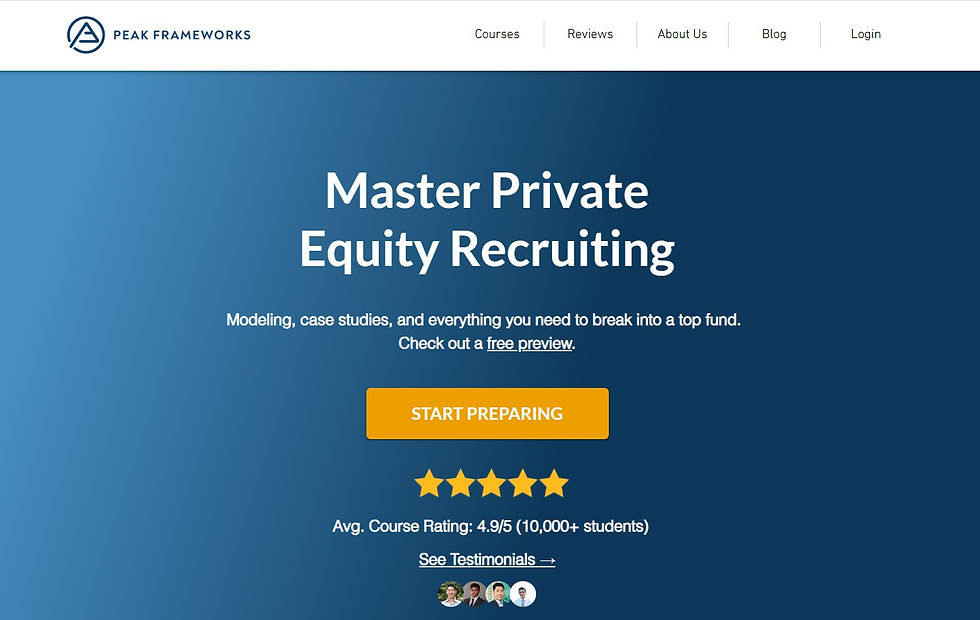
This is where the Peak Frameworks Private Equity Course fits. Former buy-side professionals with upper-middle-market and large-cap experience built it, and it covers the full recruiting lifecycle rather than one slice of it:
5 three-statement LBO model tests of increasing difficulty, covering mechanics like PIK interest, dividend recaps, and add-on acquisitions.
7 paper LBO tests drawn from real on-cycle questions, the kind asked during rushed processes.
10+ case studies previously used by mega funds, with a video tutorial on writing a case memo and building an LBO from just a 10-K.
A current headhunter coverage list mapping major North American recruiters to the firms they represent.
The course has trained over 10,000 students and carries a 4.9-out-of-5 average rating. The value isn't only the material. It's that the material mirrors how firms actually test candidates, so your practice matches the real thing.
6. Run Mock Interviews and Drill Your Story Cold
You can build a flawless model and still lose the offer in the fit round. Final rounds with partners lean heavily on fit, "stress" questions, and deep dives on your banking deals. The fix is rehearsal, not more reading.
In the one to two weeks before a process kicks off:
Drill behavioral questions cold until "walk me through your resume" and "why private equity" come out clean and concise. Our resume walkthrough guide shows how to structure that opener.
Rehearse your deal walkthroughs in 5-, 10-, and 15-minute versions, so you can flex to whatever the interviewer wants.
Do live mock interviews with someone who will push back. Defending your thesis out loud exposes the weak spots that silent prep hides.
Recap: treat the interview as a performance you rehearse, not a test you cram for.
7. Don't Overlook the Off-Cycle and Logistics
Most candidates fixate on the on-cycle weekend and ignore everything around it. Two things get overlooked again and again.
First, off-cycle recruiting. It runs throughout the year at smaller and middle-market firms, the process is slower, and offers usually start within weeks rather than 1.5 to 2 years out (Financial Edge). Off-cycle interviews lean harder on real investment thinking, so the thesis work from tips #2 and #4 matters even more.
Second, the basics on interview day. Sleep, eat, and bring a notepad. On-cycle processes can compress into a single intense weekend with exploding offers, and candidates make avoidable mistakes when they're exhausted. The work you did in months one through five is what lets you stay calm when the timeline collapses into hours.
Frequently Asked Questions
When does on-cycle private equity recruiting start?
On-cycle recruiting typically begins within the first few months of an analyst's start date, with some firms reaching out as early as July (Financial Edge). The process is short and intense, and offers are extended for roles that begin 1.5 to 2 years later. Because the runway is so short, most candidates start preparing months before the process opens. See our private equity recruiting timeline for a fuller breakdown.
What's the difference between a paper LBO and an LBO modeling test?
A paper LBO is a quick mental exercise; an LBO modeling test is a full Excel build. The paper LBO takes 5 to 10 minutes with no spreadsheet and is used in early rounds to screen candidates. The modeling test runs one to three hours and asks you to build sources and uses, a debt schedule, an operating model, and returns from scratch. Practice both. Our paper LBO tutorial covers the verbal version step by step.
Can I prepare for private equity interviews while working full-time in banking?
Yes, and most successful candidates do exactly that. The constraint is time: as an analyst you might have only two to three hours a day, so consistency matters more than marathon sessions. Build LBO fluency in the early months, develop sector views in the background, and reserve focused weekends for full model practice. A structured course helps because it removes the guesswork about what to study next.
Is an online private equity course worth it?
It's worth it when the material matches how firms actually test you. A good course saves time by consolidating model templates, real case studies, and recruiting context that would otherwise take months to assemble. The Peak Frameworks Private Equity Course was built by former buy-side professionals and includes case studies previously used by mega funds, which is why it's a common starting point for on-cycle candidates.
Start Earlier Than You Think You Need To
The best resources for private equity recruiting all point to the same principle: preparation is a head start, not a sprint. Build the technical foundation first, read like an investor, network before the process opens, and rehearse your story until it's automatic. The candidates who win offers in a compressed on-cycle weekend are the ones who did the quiet work months earlier.
Ready to compress months of prep into a few focused weekends? Get the #1 Private Equity Course and practice on the same model tests and case studies firms actually use.


