
Are Private Equity Prep Courses Worth the Money for Analysts?

If you're interested in breaking into finance, check out our Private Equity Course and Investment Banking Course, which help thousands of candidates land top jobs every year.
Overview
In our experience coaching candidates through buy-side recruiting, private equity prep courses are worth the money for most analysts who are seriously recruiting for the buy-side.
The field is competitive enough that small edges in modeling speed and case study fluency change who gets the offer. That said, a disciplined candidate can get most of the way there on free resources alone. The real trade-off is time and structure, not whether the information exists somewhere.
This guide breaks down who actually benefits from paying for a course, what professionals spend on continuing education, and how to decide whether a course like Peak Frameworks, Financeable, or Wall Street Prep makes sense for your situation.
The Short Answer: It Depends on Your Margin for Error

A private equity prep course is a paid program that teaches LBO modeling, case study interviews, and the on-cycle recruiting process, usually through video walkthroughs, Excel templates, and practice tests. The question is not whether the content is good. The question is whether paying for structure beats assembling it yourself for free.
For most analysts, the answer comes down to how thin your margin is. On-cycle private equity recruiting moves fast, and a single modeling test can decide an interview. When the gap between you and the next candidate is small, a course that sharpens your speed and removes guesswork can be the difference. When you have months of runway and strong fundamentals already, free resources may be enough.
Bottom line: Buy the course when your timeline is short, your modeling reps are limited, or the cost of missing a cycle is high. Skip it when you have time, discipline, and a clear study plan you will actually follow.
What People Spend on Continuing Education
Spending on professional development is normal, and the numbers are larger than most analysts assume.
According to the 2025 Training Industry Report data compiled by LearnExperts, U.S. companies spent an average of $874 per learner on training in 2025, up from $774 in 2024. Total U.S. training expenditures reached $102.8 billion that year.
Set against that backdrop, a finance prep course is modest. Self-study private equity programs generally run a few hundred dollars. Live, instructor-led bootcamps cost more, sometimes several thousand dollars.
Here is the comparison that matters: according to Wall Street Careers' 2026 exit guide, first-year mega-fund private equity associates at firms like Apollo, KKR, and Blackstone earn $300K to $400K all-in. Against that figure, a few hundred dollars to prepare for the interview is a small input relative to the outcome. That math is a big reason candidates buy these courses even when free material exists.
Why the Field Is Competitive Enough to Justify the Spend
Private equity recruiting is one of the most competitive processes in finance. Mega-fund associate seats are limited, the candidate pool is full of strong investment bankers, and the on-cycle timeline gives you little room to learn on the fly.
The pressure is real enough that the calendar itself became news. In 2025, several large firms, including Apollo, General Atlantic, and TPG, paused early recruiting for the 2027 associate class after JPMorgan pushed back on future-dated offers. When the process restarted, the extra runway changed how candidates prepared.
That detail captures why courses sell. When everyone has more time to prepare, the baseline rises, and the candidate who walks in with reps on real case studies has an edge. In a process this tight, a thin margin between candidates is exactly what structured prep is built to widen. For a full walkthrough of how the timeline works, see our guide to the private equity recruiting timeline.
Free Resources Work, But They Cost You in a Different Currency
You can prepare for private equity recruiting without paying a cent. Plenty of candidates do. Free blogs, YouTube walkthroughs, and public modeling exercises cover the core technical concepts, and a motivated person can build real skill from them.
The catch is effort and assembly. Free material is scattered across dozens of sources, and quality varies. You spend hours figuring out what to study, in what order, and whether a given resource is current. Some free models are oversimplified or built on outdated questions, which means you can practice the wrong thing without knowing it.
A few honest trade-offs to weigh:
Time. Free prep usually takes longer because you build the curriculum yourself.
Sequencing. Without a clear order, you may drill advanced mechanics before the fundamentals are solid.
Feedback. Free resources rarely tell you whether your model is right or your case memo is convincing.
If you have a long runway and the discipline to self-direct, free resources can absolutely get you there. To start, you can practice a paper LBO and read up on private equity headhunters, both of which we cover at no cost. The honest answer is that free works, but it asks more of you.
Who Should Buy a Course, and Who Can Skip It
Different professionals get different value from paid prep. Here is how the decision tends to break down.
A course usually pays off if you are:
An investment banking analyst heading into on-cycle recruiting with limited prep time.
A candidate from a non-target school who needs to close a knowledge gap quickly.
A career switcher moving into finance without prior modeling reps.
Someone who values structure and a verified curriculum over assembling one yourself.
You can likely skip it if you are:
Early in your timeline with months to study at your own pace.
Already strong at LBO modeling and comfortable with case studies.
Disciplined enough to follow a self-built study plan without external structure.
Notice the pattern. The course buys time, sequencing, and confidence. If you already have those, the case for paying weakens. If you do not, the spend tends to earn its keep.
How the Top Courses Compare
A few names come up repeatedly when analysts research prep. Each takes a slightly different angle.
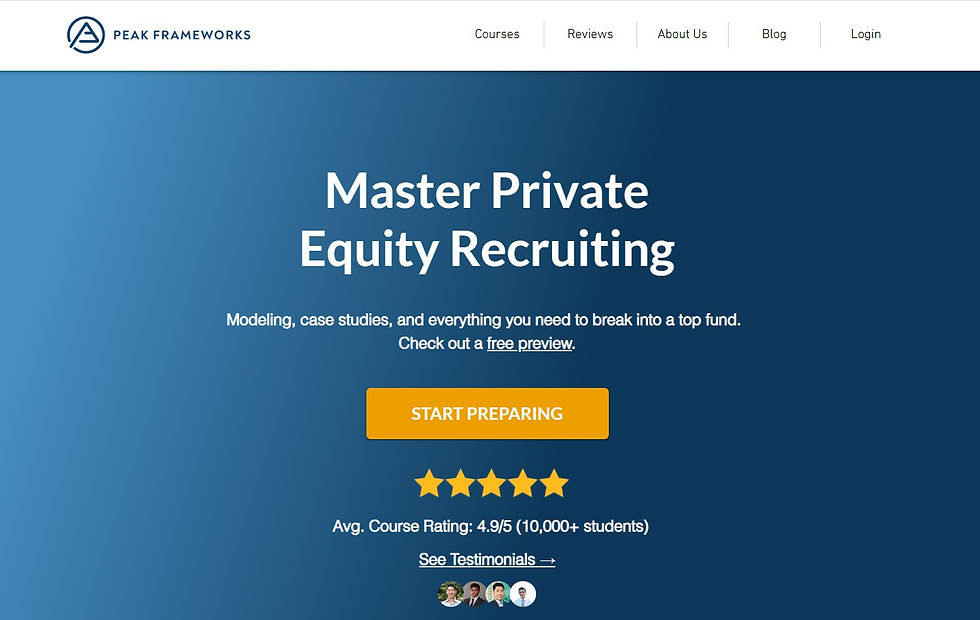
Peak Frameworks focuses on private equity recruiting specifically, with real LBO model tests, case studies previously used by mega-funds, headhunter coverage, and a buy-side resume database reviewed by North American recruiters. It was built by professionals with upper-middle-market and large-cap private equity experience.
Financeable offers finance interview and recruiting prep aimed at students and early-career candidates.
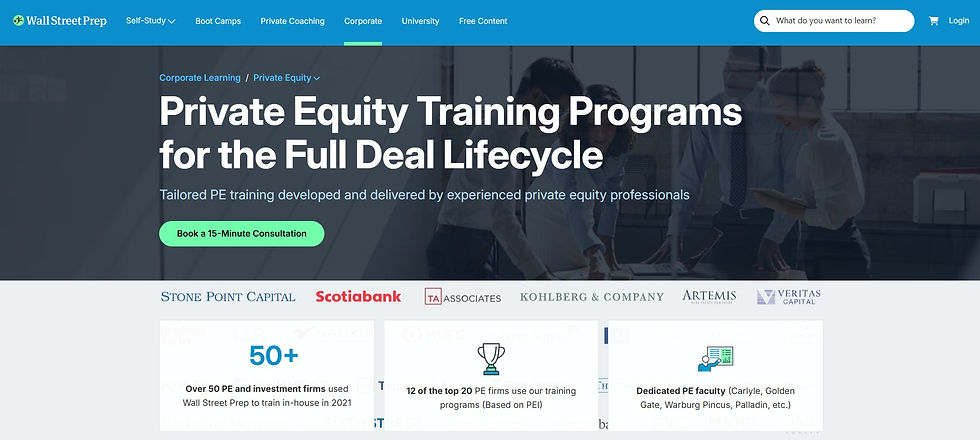
Wall Street Prep is known for broad financial modeling self-study, including LBO, DCF, and three-statement modeling, and is widely used for general modeling training.
Source: Wall Street Prep
The right choice depends on what you are solving for. If your goal is the private equity interview itself, a recruiting-specific course maps more directly to the case studies and modeling tests you will face. If you want general modeling fundamentals, a broader program may fit. Pick the course that matches the gap you actually have, not the one with the longest feature list. If your resume is the weak point, that is a separate fix, and our resume and cover letter course addresses it directly.
Frequently Asked Questions
Are private equity prep courses worth it for analysts?
For most analysts recruiting on-cycle, a private equity prep course is worth the money because it compresses prep time and reduces guesswork before high-stakes modeling tests. The value is highest when your timeline is short or your modeling reps are limited. If you have months to study and strong fundamentals, free resources can be enough.
How much do private equity prep courses cost?
Most self-study private equity courses cost a few hundred dollars. Live, instructor-led bootcamps run higher, sometimes into the thousands.
Can I prepare for private equity recruiting for free?
Yes, you can prepare using free resources, including blogs, YouTube walkthroughs, and public modeling exercises. The trade-off is time and effort: you assemble the curriculum yourself, quality varies, and you get little feedback. Free prep rewards discipline and a long timeline.
What is the difference between Peak Frameworks and Wall Street Prep?
Peak Frameworks is built around private equity recruiting specifically, with case studies used by mega-funds, model tests, and headhunter coverage. Wall Street Prep is known for broad financial modeling self-study across LBO, DCF, and three-statement modeling. Choose based on whether you need recruiting-specific prep or general modeling fundamentals.
The Takeaway
Private equity prep courses are worth the money when your margin for error is thin: a short timeline, limited modeling reps, or a competitive cycle where every candidate is prepared. They buy you structure, sequencing, and confidence that free resources can match only with significantly more effort. If you have time and discipline, free material can get you there. If you do not, a course earns its cost quickly against what a buy-side role pays.
If you are recruiting this cycle and want a structured path built by people who have sat on both sides of the table, get the Peak Frameworks Private Equity Course and start with the case studies and model tests that mirror what mega-funds actually ask.
