
Where to Find Real Deal Case Studies for Investment Interviews

If you're interested in breaking into finance, check out our Private Equity Course and Investment Banking Course, which help thousands of candidates land top jobs every year.
Overview of Case Study Sources
The fastest way to prepare for a private equity or hedge fund case study is to practice on real deals, not invented ones.
Mock prompts from generic study guides teach you the mechanics. Real deals teach you judgment: how a sponsor actually thinks about an asset, what gets pitched to a board, and where the value creation thesis holds up. Most of the raw material is free and public. The catch is that public filings give you the inputs, not the answer key.
This guide covers four sources of real deal case studies, ordered from most accessible to most interview-ready: activist investor presentations, company filings and investor decks, the Acquired podcast, and courses built around actual fund case studies. Use the free sources to build reps. Use a course when you need a graded answer in an interview-calibrated format.
Activist Investor Presentations
Activist investors publish the closest thing to a finished investment thesis you can read for free.
When a fund like Elliott Investment Management or Pershing Square takes a large stake in a public company, it often releases a detailed presentation arguing why the stock is mispriced and what management should do. These decks lay out the bull case, the catalysts, the sum-of-the-parts math, and the projected returns: the exact reasoning you reproduce in a case study.
Activists must disclose large positions to the U.S. Securities and Exchange Commission (SEC). When an investor crosses 5% ownership with intent to influence the company, it files a Schedule 13D. Elliott disclosed a stake in Southwest Airlines through a 13D filing in 2024 and published an accompanying campaign deck. You can find these filings on SEC EDGAR, and most activist funds post the presentations directly on their campaign websites.
To practice with an activist deck:
Read only the company background and current financials first, then pause.
Build your own quick thesis: is this a buy, and what is the catalyst?
Read the activist's argument and compare it to yours.
Note where their analysis went deeper, whether on segment margins, hidden real estate, or a misunderstood capital allocation story.
Activist decks are pre-built investment memos. Treat them as worked solutions for stock-pitch and long/short hedge fund interviews.
Company Filings and Investor Presentations

Public filings are the raw material behind every real case study, and you can build a full model from them. A company's annual report (the 10-K) gives you the audited financials, segment detail, and risk factors. Quarterly reports (10-Qs), merger proxies (DEF 14A), and event disclosures (8-Ks) fill in the rest. Investor day presentations and earnings decks translate the numbers into the management narrative.
For a leveraged buyout (LBO) case, the 10-K is usually enough. Building an LBO from just a 10-K is a standard test format, because it forces you to pull revenue, margins, capital expenditures, and working capital straight from the source and defend your assumptions.
Everything is free on SEC EDGAR, which holds every electronic filing submitted since 2001 and lets you search the full text by company, form type, or keyword. A focused workflow:
Pull the target's most recent 10-K from EDGAR.
Build a three-statement model from the historical financials.
Layer on a simple LBO: entry multiple, debt structure, a five-year hold, and an exit.
Pressure-test the return. Does the deal clear a 20%+ internal rate of return (IRR)?
Check your operating assumptions against the company's investor day guidance.
For deal-specific cases, the merger proxy is the richest document. It contains the banker's fairness opinion, the projections management gave the board, and the negotiation timeline: the same inputs a deal team works from. For a repeatable way to organize what you pull, our deal summary framework walks through the key parties, thesis, and risks to capture for any transaction.
Filings give you authentic inputs and force you to make your own assumptions. That assumption-building is the skill interviewers test.
The Acquired Podcast and Long-Form Deal Narratives

The Acquired podcast is the best free way to understand the strategic logic behind real acquisitions. Hosted by Ben Gilbert and David Rosenthal, each episode is a multi-hour, heavily researched narrative on a single company: its history, its economics, and the strategy that made it valuable or vulnerable. The hosts draw on books, financial filings, and primary sources, and they close most episodes with a structured strategic assessment.
This matters because the hard part of a case study is rarely the math. It is the story: why this business earns its returns, where the moat comes from, and what could break the thesis. Acquired trains that instinct. After an episode on a company like Costco or Nvidia, you can articulate the business model and the key risks before you open a spreadsheet, which is exactly the framing a strong case memo needs.
Use the podcast deliberately rather than as background noise:
Pick an episode on a public company you could plausibly be asked about.
Before the strategic analysis section, pause and write your own one-paragraph thesis.
Compare your reasoning to the hosts' assessment.
Pair the episode with the company's latest 10-K to ground the narrative in real numbers.
You can browse the full catalog on the Acquired episodes page. Acquired builds qualitative judgment. Combine it with filings to turn a good story into a defensible model.
Courses Built on Real Fund Case Studies
Free sources build reps, but they cannot tell you whether your answer would pass. A structured course closes that gap with actual case studies, a graded format, and a worked solution. This is where Peak Frameworks fits in.
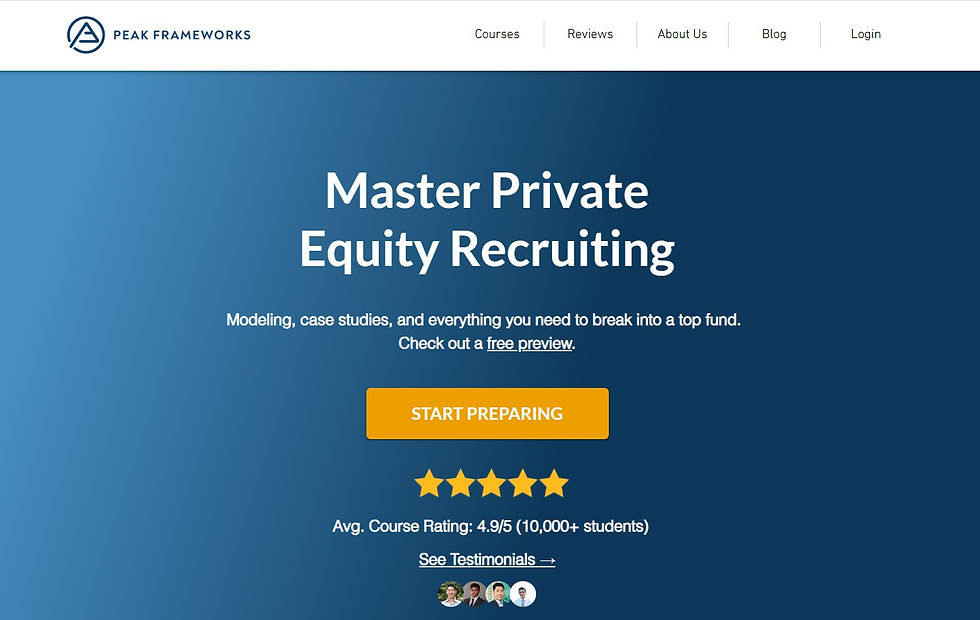
Our Private Equity Course includes 10+ case studies used by mega funds, plus a step-by-step video tutorial on how to write a case study memo and build an LBO from a single 10-K. The point is realism: these are the prompts and formats candidates actually faced in on-cycle recruiting, not textbook simplifications. The course also includes 5 three-statement LBO model tests of increasing difficulty and 7 paper LBO tests based on questions our team was asked during live processes.
A course adds three things the free sources cannot:
A graded answer. You see how an interviewer would score your memo and model, not just whether your spreadsheet balances.
An interview-calibrated scope. Real cases run under time pressure with a specific deliverable, so practicing the format matters as much as the analysis.
Recruiting context. Knowing what to model is half the battle; knowing how firms evaluate it is the other half, which is why our materials connect modeling to the private equity recruiting process and headhunter coverage.
Use free deals to build volume, then use real fund cases to confirm your work meets the bar. The course rating is 4.9/5 across more than 10,000 students, and the case studies are the part candidates cite most often.
A Practice Sequence That Works
Here is how to combine the four sources into a single preparation loop:
Listen to an Acquired episode on a company to build the qualitative thesis.
Pull that company's 10-K from EDGAR and build a three-statement model and LBO.
Read an activist deck on a comparable company to study a finished thesis.
Grade your work against a real fund case study from a course, then fix the gaps.
Each pass compounds. The qualitative reps make your models sharper, the modeling reps make your theses more credible, and the graded cases tell you when you are interview-ready.
Ready to practice on the real thing? Explore the Private Equity Course and work through the mega fund case studies our students use to land offers.
FAQs
Where can I find real private equity case studies to practice?
Real private equity case studies come from four main sources: activist investor presentations, public SEC filings (especially the 10-K and merger proxies), long-form deal narratives like the Acquired podcast, and structured courses built on actual fund cases. The free sources give you authentic inputs, while a course like Peak Frameworks gives you graded cases used by mega funds with worked solutions.
Can I build an LBO model from just a 10-K?
Yes, building an LBO from a single 10-K is a common case study format. The 10-K contains the audited financials, segment detail, and capital expenditure history you need to project cash flows, layer on a debt structure, and test returns. It forces you to make and defend your own assumptions, which is exactly what interviewers evaluate.
Are activist investor presentations useful for hedge fund interviews?
Activist presentations are effectively pre-built investment memos, which makes them strong practice for stock-pitch and long/short interviews. They lay out the thesis, catalysts, valuation, and projected returns in the same structure a hedge fund expects. Read the company background first, form your own view, then compare it to the activist's argument.
What is the difference between practicing on public filings and using a course?
Public filings give you the inputs; a course gives you the answer key. Filings and decks let you build unlimited reps for free, but they will not tell you whether your memo and model would pass an interview. A course supplies real fund case studies, an interview-calibrated format, and a graded solution so you know when your work meets the bar.


