
Index Funds: A Comprehensive Guide for Investors

If you're interested in breaking into finance, check out our Private Equity Course and Investment Banking Course, which help thousands of candidates land top jobs every year.
What Are Index Funds?

Index funds are a type of mutual fund or exchange-traded fund (ETF) that aims to replicate the performance of a specific market index. An index is a benchmark that represents a particular segment of the financial market, such as the S&P 500, NASDAQ Composite, or Dow Jones Industrial Average.
The fund's portfolio is constructed to match or track the components of the index, which helps investors achieve returns that align with the broader market performance.
Types of Index Funds
Stock Index Funds: Track stock market indices, such as the S&P 500 or the MSCI World Index.
Bond Index Funds: Replicate the performance of bond market indices, such as the Bloomberg Barclays U.S. Aggregate Bond Index.
Sector or Industry Index Funds: Focus on specific sectors, like technology or healthcare, and track indices within those sectors.
International Index Funds: Invest in foreign markets by tracking global indices, such as the FTSE All-World Index.
How Do Index Funds Work?
Passive Management Strategy
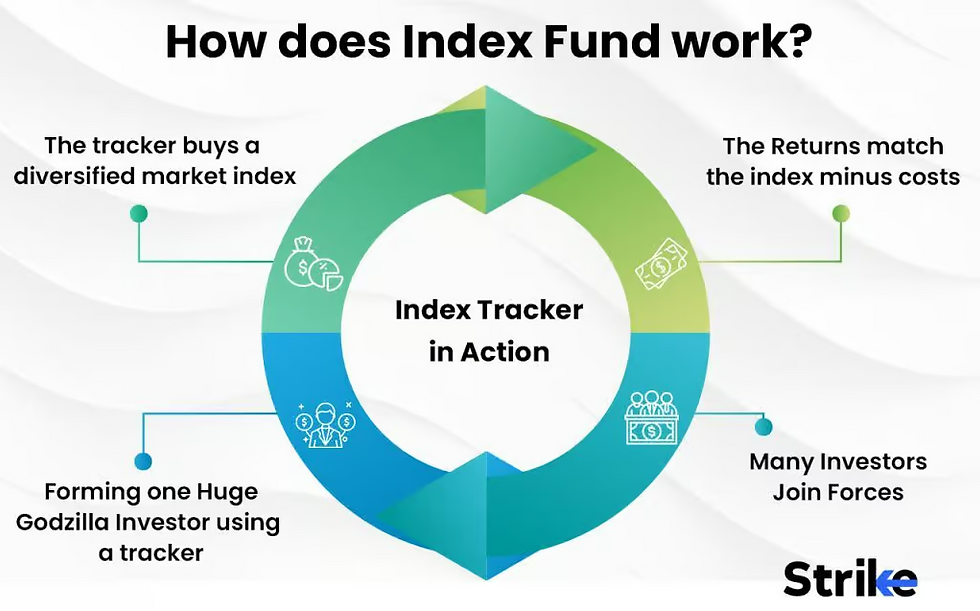
Index funds use a passive management strategy, meaning the fund manager does not actively select stocks or bonds. Instead, they replicate the index's performance by holding the same securities in the same proportions as the index. This approach contrasts with actively managed funds, where managers make strategic investment decisions to outperform the market.
Tracking the Index
To track an index accurately, an index fund must purchase all or a representative sample of the securities included in the index. For example, an S&P 500 index fund will hold stocks from all 500 companies in the S&P 500. If the index rebalances or changes, the fund must adjust its holdings accordingly.
Advantages of Investing in Index Funds
1. Low Costs
Lower Expense Ratios: Index funds generally have lower expense ratios compared to actively managed funds. This is because they require less frequent trading, and there is no need to pay high salaries to portfolio managers or analysts.
Reduced Transaction Costs: Fewer transactions mean lower brokerage fees and transaction costs, further minimizing the overall cost for investors.
2. Diversification
Index funds provide broad exposure to various asset classes, sectors, or markets. By holding a wide range of securities, they reduce the risk associated with individual stock or bond selection.
3. Consistent Performance
Market Matching: Index funds aim to match the performance of the underlying index. While they may not outperform the market, they also tend not to underperform significantly.
Less Volatility: Due to their diversified nature, index funds often experience less volatility compared to individual stocks or bonds.
4. Simplicity and Transparency
Ease of Understanding: Investors can easily understand index funds because they simply replicate the performance of an existing index.
Transparent Holdings: The fund's holdings are publicly available, allowing investors to know exactly what they are investing in.
Disadvantages of Investing in Index Funds
1. Lack of Flexibility
Since index funds must follow the index they track, fund managers have no flexibility to react to market conditions or take advantage of opportunities. This can be a disadvantage in volatile or bear markets.
2. Potential for Lower Returns
No Outperformance: Because index funds are designed to match market performance, they will not outperform the market. In contrast, actively managed funds have the potential to generate higher returns, albeit with greater risk.
Tracking Error: Although index funds aim to replicate the index, slight differences in holdings or management practices can lead to minor deviations from the index's performance, known as tracking errors.
3. Limited Downside Protection
Index funds provide limited protection against market downturns. Since they replicate the index, any significant market decline will directly impact the fund's performance.
How to Choose the Right Index Fund
1. Understand Your Investment Goals
Before investing in an index fund, it's crucial to define your investment goals. Are you looking for long-term growth, income, or a combination of both? Knowing your objectives will help you select an index fund that aligns with your needs.
2. Compare Expense Ratios
Expense ratios vary among index funds. Lower expense ratios mean more of your money is working for you. Compare the costs of different funds to ensure you choose one with a competitive fee structure.
3. Evaluate the Index
Different index funds track different indices. Evaluate the index to understand what it represents. For example, if you are interested in large-cap U.S. stocks, consider an S&P 500 index fund. If you prefer global exposure, look at an international index fund.
4. Consider the Fund's Size and Liquidity
Fund Size: Larger funds often have lower expense ratios and greater liquidity. However, they may also have a larger tracking error due to the difficulty in managing substantial assets.
Liquidity: High liquidity ensures you can easily buy or sell shares without significantly impacting the fund's price.
5. Review the Fund's Historical Performance
While past performance does not guarantee future results, it can provide insights into how well the fund has tracked its index. Look for a consistent performance that closely matches the underlying index.
Common Misconceptions About Index Funds
1. All Index Funds Are the Same
Not all index funds are created equal. They can vary significantly in terms of the indices they track, the fees they charge, and their overall structure. It's essential to research and understand the differences before investing.
2. Index Funds Always Outperform Actively Managed Funds
While index funds often outperform actively managed funds due to lower costs, this is not always the case. In certain market conditions, active management can provide higher returns.
Tips for Investing in Index Funds
Start Early: The earlier you start investing, the longer your investment has to grow. Index funds are suitable for long-term investment due to their consistent market-tracking performance.
Regular Contributions: Consider a dollar-cost averaging strategy, where you invest a fixed amount regularly. This approach reduces the impact of market volatility over time.
Diversify: Although index funds provide diversification, consider holding a mix of funds that track different indices to further spread your risk.
Monitor Your Portfolio: Even though index funds require less attention than actively managed funds, it's essential to periodically review your portfolio to ensure it aligns with your financial goals.
Conclusion
Index funds offer a simple, cost-effective way to gain exposure to a broad range of assets, providing investors with diversification, low costs, and consistent performance. While they have certain limitations, such as lack of flexibility and limited downside protection, they remain an attractive option for long-term investors.
By understanding how index funds work, evaluating your options carefully, and aligning your investment with your financial goals, you can effectively use index funds as part of a diversified investment strategy.


