
Top Finance Courses for Graduates: 5 Programs Compared

If you're interested in breaking into finance, check out our Private Equity Course and Investment Banking Course, which help thousands of candidates land top jobs every year.
Our Favorite Courses for High Finance Jobs
If you are a finance graduate weighing finance courses for graduates, the fastest way to close the gap between your degree and a real offer is a structured course built around how firms actually test candidates.
The five programs below each do this well, and the right pick depends on your target role: investment banking, private equity, or growth equity.
Here is the short answer. For private equity recruiting, the Peak Frameworks Private Equity Course gives you real LBO model tests and mega fund case studies. For broad financial modeling depth, Breaking Into Wall Street (BIWS) is the most comprehensive. For bank-grade fundamentals, Financial Edge mirrors the training new analysts receive on the job. For growth-stage roles, the Growth Equity Interview Guide is the rare specialist resource. And for visual, concept-first learning, Financeable rebuilds the fundamentals from the ground up.
Why Finance Graduates Use Courses to Prepare

Finance interviews test specific, learnable knowledge: building a leveraged buyout (LBO) model, walking through the three financial statements, valuing a company, and pitching a stock. Recruiting moves fast, and the timeline is unforgiving. In private equity, larger U.S. firms run an on-cycle process that interviews and hires candidates roughly 1.5 to 2 years before their start dates, often compressing first rounds, modeling tests, and superdays into a matter of days, as described in Mergers & Inquisitions' on-cycle recruiting guide. If you are not ready the day it kicks off, you are behind.
That is why so many candidates pay for prep. As we explain on our own course page, paid resources are not strictly required to land an offer, but many people use guides, courses, and coaching because the process is so competitive and the industry is so opaque. A good course saves prep time and gives you an information advantage over peers who are guessing.
The value is not the videos alone. It is the practice reps: building models from a blank sheet, writing case memos, and answering the technical questions a firm will actually ask. Courses accelerate learning because they replace scattered forum threads with a sequenced path, and they let you rehearse under realistic conditions before the real test arrives.
The 5 Best Finance Courses for Graduates
Each course below lists who created it, what you get, and the candidate it fits best. Use the comparison table at the end to match a program to your target role.
1. Peak Frameworks Private Equity Course
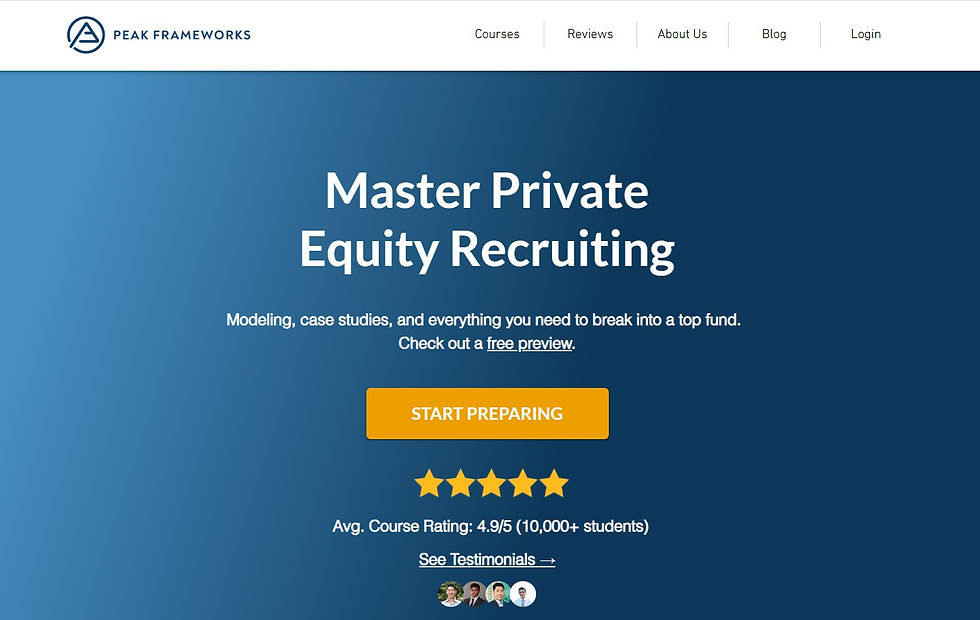
Best for candidates recruiting for private equity and buy-side roles that require LBO modeling. Our Private Equity Course is built around the exact deliverables firms use to screen candidates: model tests, case studies, and headhunter intelligence.
Peak Frameworks was founded in 2020 by Matt Ting, who spent his career in private equity and investment banking at Silver Lake Partners, Providence Equity, and Evercore. The course also draws on industry advisors, including Patrick Fong, a Vice President at TPG Capital and a Baker Scholar from Harvard Business School, and Ryan Yaraghi, a Principal at Searchlight Capital Partners who previously worked at Evercore.
What you get:
5 three-statement LBO model tests of increasing difficulty, covering mechanics like PIK interest, dividend recaps, and add-on acquisitions
7 paper LBO tests based on actual on-cycle questions
More than 100 videos and 13-plus hours of content
10-plus case studies used by mega funds, with a walkthrough on building an LBO from a 10-K
A current headhunter coverage list mapping the major North American recruiters to the firms they represent
If you want to understand how fast this process moves before you commit, read our breakdown of the private equity recruiting timeline, then practice with our free paper LBO walkthrough.
2. Breaking Into Wall Street (BIWS)

Best for candidates who want the most thorough financial modeling library. Breaking Into Wall Street built its reputation on depth, using real modeling tests and interview case studies across investment banking and private equity.
BIWS was founded by Brian DeChesare, a former investment banker who also created the finance careers blog Mergers & Inquisitions, as profiled by Forbes. His platform is one of the oldest in the space.
What you get is breadth: courses spanning Excel, accounting, valuation, financial modeling, PowerPoint, and industry-specific modeling, sold individually or as bundles. The trade-off is scope. BIWS is detailed, so it suits candidates who want comprehensive coverage rather than a tight two-hour cram plan. If your timeline is long and you want to build modeling skills you will use on the job, the depth is an advantage.
3. Financial Edge

Best for candidates who want the same fundamentals banks teach their incoming analysts. Financial Edge delivers practitioner-led programs in accounting, modeling, valuation, and mergers and acquisitions, structured as a certification its team also uses to train new hires.
Financial Edge describes itself as the training provider for Wall Street's top investment banks, and it confirmed that positioning in a 2023 partnership announcement with Northeastern University London to launch a Master's in Global Investment Banking. Its instructors are former bankers and accountants from major firms, including co-founder Alastair Matchett, an ex-J.P. Morgan investment banker. Financial Edge is now part of Wall Street Prep.
What you get is a structured "micro-degree" path that maps to a recognized certification. The style is bank-grade and rigorous rather than recruiting-shortcut focused, which makes it a strong fit for incoming analysts who want to arrive on the desk already fluent in the core skills.
4. Growth Equity Interview Guide
Best for candidates recruiting specifically for growth equity and late-stage venture roles. This is the rare resource built only for growth-stage investing, where pure-play prep is genuinely scarce.
The guide was created by Mike Hinckley, who has more than 10 years of growth-stage experience. He was an investor at General Atlantic, a leading growth equity firm, and operated at one of its portfolio companies before earning a Wharton MBA, according to the Growth Equity Interview Guide site.
What you get is focused coverage of growth investing: LBO and paper LBO modeling adapted for minority deals, market and thesis frameworks, a curated job board, and case study prep. Because growth equity recruiting borrows mechanics from private equity but fills more roles off-cycle, this course pairs well with general buy-side prep. For background on the strategy itself, see our primer on what growth equity is.
5. Financeable
Best for candidates who learn visually and want to build intuition before memorizing formulas. Financeable teaches finance through motion-based visual frameworks rather than static slides, with interview prep embedded after each chapter.
The founder is Mike Kimpel, who, per Financeable's published materials, spent more than 15 years in deal roles at firms including UBS, Golden Gate Capital, and HIG Capital, and has taught as faculty in Columbia Business School's value investing program. That background informs the course's plain-English, framework-first style.
What you get are targeted course packages for investment banking and private equity, organized by goal and skill level, with a "desk-ready" focus that extends past the interview into the first years on the job. If you have struggled with prep that asks you to memorize formulas without explaining the logic, the visual, concept-first approach is the differentiator.
How These Finance Courses Compare
Course | Created by | Best for | Standout feature |
Peak Frameworks Private Equity Course | Matt Ting (ex-Silver Lake, Providence, Evercore) | Private equity recruiting | Real LBO model tests, mega fund case studies, headhunter list |
Breaking Into Wall Street | Brian DeChesare (ex-banker) | Comprehensive modeling depth | Largest modeling library across IB and PE |
Financial Edge | Ex-J.P. Morgan and other bank instructors | Bank-grade fundamentals | Certification used to train new analysts |
Growth Equity Interview Guide | Mike Hinckley (ex-General Atlantic) | Growth equity and late-stage VC | Only major pure-play growth equity prep |
Financeable | Mike Kimpel (ex-UBS, Golden Gate, HIG) | Visual, concept-first learners | Motion-based frameworks, desk-ready focus |
How to Choose the Right Course
Start with your target role, not the price tag. The mechanics overlap, but the testing format differs by seat.
Private equity: Prioritize a course built around LBO model tests and case studies, like the Peak Frameworks Private Equity Course. On-cycle gives you no time to learn modeling from scratch once it starts.
Investment banking: Lead with fundamentals. Financial Edge and BIWS both build the accounting, valuation, and modeling base you need for technical interviews and the desk. Our Investment Banking Course covers the same three-statement and valuation core.
Growth equity or late-stage VC: Use the Growth Equity Interview Guide for the specialist material, and pair it with general LBO practice since the modeling overlaps.
You learn better visually: Financeable's frameworks help if formula-first courses have not stuck.
Whatever you choose, the deciding factor is reps. Build models from blank sheets, write practice memos, and rehearse answers out loud. The course supplies the structure; the practice creates the offer.
FAQs
Do you need a paid course to break into finance?
No, a paid course is not required to land an offer. Many candidates succeed using free articles, YouTube videos, and networking. That said, many people pay for prep because recruiting is competitive and the industry is opaque, so a structured course can save significant time and give you an information edge over peers.
Which finance course is best for private equity recruiting?
For private equity, choose a course built around LBO model tests and case studies. The Peak Frameworks Private Equity Course is designed for on-cycle recruiting specifically, with three-statement LBO tests, paper LBOs, mega fund case studies, and a headhunter coverage list. Most top funds give a modeling test, so practicing realistic cases matters more than passive video watching.
How early should finance graduates start preparing?
Start before recruiting kicks off, ideally well in advance of your target cycle. In private equity, on-cycle can begin only a few months into a banking analyst's first year, for roles starting over a year later. Learning LBO modeling cold before the process opens is the single highest-leverage move, because there is little time to learn it once interviews begin.
Are growth equity interviews different from private equity interviews?
Yes, but they overlap heavily. Growth equity uses less leverage and focuses more on market sizing, thesis development, and minority-stake structuring, while still testing modeling skills similar to a standard LBO. Many growth equity funds mirror private equity recruiting timing, and more roles are filled off-cycle, so dedicated growth prep paired with general modeling practice works well.
Ready to prepare for the most competitive buy-side process? Get the #1 Private Equity Course and practice with the same model tests, case studies, and headhunter intelligence top firms use to screen candidates.


