
Should You Start Practicing Ethical Investing?

If you're interested in breaking into finance, check out our Private Equity Course and Investment Banking Course, which help thousands of candidates land top jobs every year.
Definition of Ethical Investing

In recent years, ethical investing has transitioned from a niche interest to a mainstream demand, reflecting a growing consciousness among investors about the broader impact of their financial decisions.
Ethical investing, or socially responsible investing (SRI), marries the pursuit of financial gain with the desire to generate positive social and environmental outcomes. This approach not only addresses the investor's financial goals but also considers environmental, social, and governance (ESG) factors.
The Foundations of Ethical Investing
Understanding ESG
The core of ethical investing lies in ESG criteria:
Environmental considerations include climate change, resource depletion, and pollution.
Social criteria examine how companies manage relationships with employees, suppliers, customers, and communities.
Governance involves leadership, executive pay, audits, internal controls, and shareholder rights.
Ethical Investing vs. Traditional Investing
Unlike traditional investing, which focuses primarily on financial returns, ethical investing integrates ESG factors into the decision-making process. This integration aims to identify investments that offer sustainable returns by considering the long-term impact of business practices on society and the environment.
Ethical Investing in Practice
Approaches to Ethical Investing
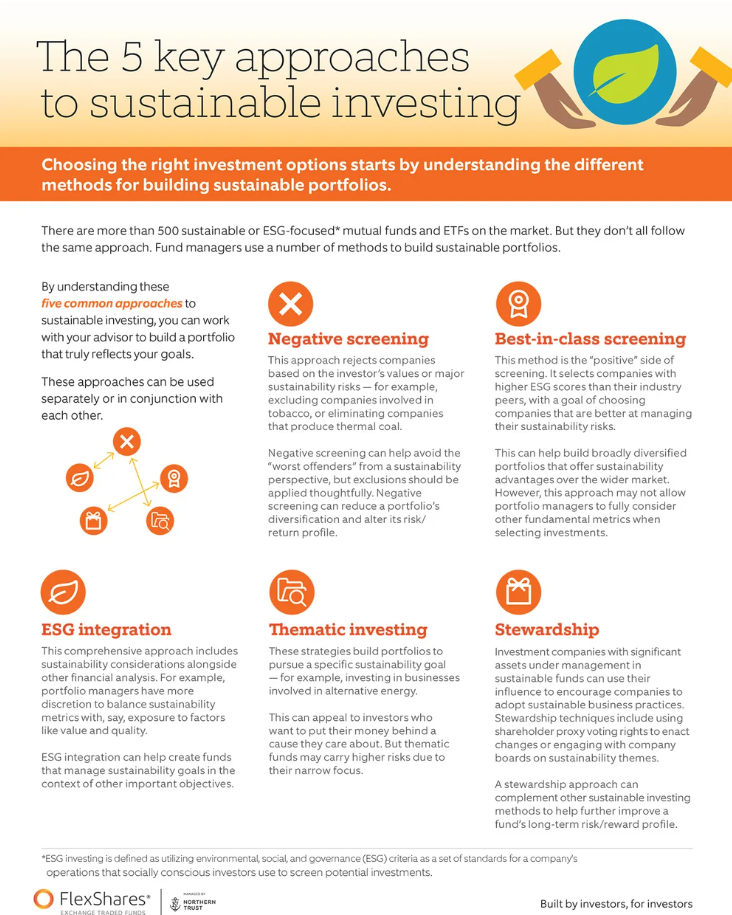
There are several strategies for implementing ethical investing:
Negative screening excludes sectors or companies not aligning with certain ethical standards.
Positive screening seeks out companies or sectors with positive ESG performance.
ESG integration systematically incorporates ESG information into financial analysis.
Impact investing focuses on companies or projects with the intention of generating a measurable, beneficial social or environmental impact alongside a financial return.
Shareholder advocacy involves investors using their rights to influence corporate behavior.
Tools and Resources
Investors have access to a variety of tools to help evaluate ethical investments, including specialized indexes (e.g., the MSCI ESG Leaders Indexes), mutual funds, ETFs, and ESG rating agencies.
The Business Case for Ethical Investing
Financial Performance
Studies have shown that investments incorporating ESG criteria can perform as well as, if not better than, traditional investments, challenging the myth that ethical investing means sacrificing returns.
Risk Management
Ethical investing can help mitigate risks by avoiding companies with poor ESG practices that may face regulatory fines, reputational damage, or operational challenges.
Investor Demand and Market Growth
The demand for ethical investment options is rising sharply, with an increasing number of investors seeking to align their portfolios with their values, driving significant growth in the market.
Challenges and Criticisms
Greenwashing
One of the main challenges in ethical investing is navigating the issue of greenwashing, where companies falsely portray their products, activities, or policies as environmentally friendly. Investors must be vigilant and conduct thorough due diligence.
Performance Myths
Despite the evidence supporting the competitive performance of ethical investments, misconceptions persist. It's essential to debunk these myths by highlighting empirical research and case studies that demonstrate the financial viability of ethical investing.
Navigating Complexity
The complexity of evaluating ESG criteria can be daunting. The variability in standards and metrics makes it challenging to assess and compare investments accurately. However, advancements in data analysis and reporting standards are improving transparency and comparability.
Future Trends in Ethical Investing
Technological Innovations
Technological advancements, such as AI and big data analytics, are enhancing the ability to assess and integrate ESG factors into investment decisions, making ethical investing more accessible and effective.
Regulatory Changes
Anticipated regulatory changes, particularly related to climate risk disclosure and ESG reporting standards, are expected to further drive the integration of ethical considerations into investing.
The Role of Institutional Investors
Large institutional investors are increasingly embracing ethical investing, signaling a significant shift in investment practices and potentially shaping the market's future direction.
Conclusion
Ethical investing represents not just a financial strategy but a commitment to a sustainable future. By integrating ESG criteria into investment decisions, investors can contribute to positive social and environmental outcomes without compromising on financial performance.
As the market for ethical investments continues to grow, fueled by technological innovations, regulatory changes, and shifting investor preferences, the opportunities for making a meaningful impact through investment choices are expanding. For those looking to navigate the intersection of profit and principles, ethical investing offers a path to align financial goals with personal values and societal well-being.
In a rapidly evolving financial landscape, staying informed and adaptable is key. Investors should consider leveraging available tools and resources, engage in continuous learning, and perhaps most importantly, approach ethical investing with a critical eye to navigate its complexities and capitalize on its opportunities. The journey towards ethical investing is not only a pursuit of financial returns but a stride towards a more equitable and sustainable future.


