
Consumption in Economics: An In-Depth Analysis

If you're interested in breaking into finance, check out our Private Equity Course and Investment Banking Course, which help thousands of candidates land top jobs every year.
What is Consumption?
In economics, consumption refers to the expenditure on goods and services by individuals, households, and the public.
Consumption involves the final use of goods and services for personal satisfaction or utility.
Consumption is distinct from investment, which refers to the acquisition of goods and services that will be used for future production.
The Role of Consumption in Economic Theory
Consumption is integral to understanding how economies function because it:
Influences Aggregate Demand: Consumption accounts for a significant proportion of total demand in an economy, driving production, employment, and income levels.
Reflects Living Standards: Consumption patterns provide insight into the quality of life and living standards within a country.
Guides Policy Decisions: Governments and central banks consider consumption trends when formulating monetary and fiscal policies.
Determinants of Consumption
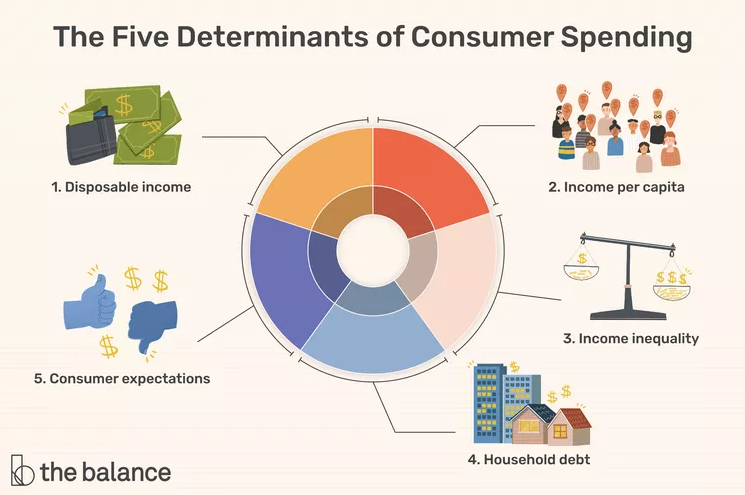
Several factors influence how individuals and households consume goods and services. These determinants include:
1. Income Levels
The most significant determinant of consumption is disposable income (income after taxes and transfers). Generally, as income increases, consumption rises, although the rate of increase diminishes over time (known as the marginal propensity to consume).
2. Wealth and Asset Holdings
Wealth, including assets like real estate, stocks, and savings, also affects consumption patterns. A rise in wealth typically boosts consumer confidence, leading to increased spending.
3. Interest Rates
Interest rates impact borrowing costs and savings returns. Lower interest rates encourage borrowing and spending, while higher rates incentivize saving over consumption.
4. Consumer Confidence
Consumer confidence reflects how optimistic or pessimistic individuals feel about their future financial situation. Higher confidence levels usually lead to higher consumption.
5. Inflation and Price Levels
Inflation erodes purchasing power, reducing the ability of consumers to buy goods and services. Conversely, stable prices can enhance consumption by making products more affordable.
6. Government Policies
Taxation, subsidies, social security, and other government policies can directly influence consumption by altering disposable income or changing incentives to spend.
7. Cultural and Social Factors
Consumption habits vary significantly across cultures and social groups. Cultural norms, traditions, and social status can influence what, how, and why people consume.
Types of Consumption
Economists categorize consumption into several types to analyze spending patterns more accurately:
1. Durable Goods Consumption
Durable goods are items with a long lifespan, such as cars, appliances, and furniture. These goods often require substantial investment and are sensitive to economic cycles. Consumption of durable goods typically rises during economic expansions and falls during recessions.
2. Non-Durable Goods Consumption
Non-durable goods include items that are consumed quickly, like food, clothing, and personal care products. Consumption of non-durable goods tends to be more stable over time compared to durable goods.
3. Services Consumption
Services such as healthcare, education, entertainment, and travel are intangible and cannot be stored. As economies develop, spending on services usually grows faster than spending on goods.
Consumption and Saving Relationship
Consumption and saving are two sides of the same coin. The portion of income not spent on consumption is saved. Economists use the following concepts to describe the relationship between consumption and saving:
1. Marginal Propensity to Consume (MPC)
MPC measures the proportion of additional income that a household spends on consumption. For instance, if a household’s MPC is 0.8, it means that for every extra dollar earned, 80 cents will be spent on consumption.
2. Marginal Propensity to Save (MPS)
MPS is the fraction of additional income that is saved rather than spent. It is the complement of MPC (MPC + MPS = 1).
3. Life-Cycle Hypothesis
The life-cycle hypothesis suggests that individuals plan their consumption and saving behavior over their lifetime, aiming to maintain a stable living standard. People save during their working years and spend during retirement.
4. Permanent Income Hypothesis
The permanent income hypothesis posits that consumption is determined by an individual’s long-term average income rather than current income. Temporary fluctuations in income have less impact on consumption compared to permanent changes.
Consumption in Macroeconomic Models
Consumption plays a critical role in various macroeconomic models used to analyze and forecast economic performance. Some of these models include:
1. Keynesian Consumption Function
The Keynesian consumption function posits that current consumption depends primarily on current income. According to this model, consumption is a linear function of disposable income, with a positive but less-than-one slope, indicating that as income increases, consumption also rises but at a slower rate.
2. IS-LM Model
The IS-LM (Investment-Savings, Liquidity-Money) model is used to analyze how consumption, investment, and monetary factors interact in the economy. The IS curve represents equilibrium in the goods market, where higher consumption shifts the curve, indicating higher output and income levels.
3. Rational Expectations Model
The rational expectations model suggests that individuals make consumption decisions based on their expectations of future economic conditions. This model incorporates the idea that people use all available information to make informed decisions, minimizing the impact of policy changes on consumption.
Impact of Consumption on Economic Growth
Consumption is a crucial driver of economic growth, particularly in developed economies where household spending constitutes a significant share of GDP. High consumption levels typically lead to increased production, employment, and income, creating a positive feedback loop.
However, excessive consumption can lead to imbalances, such as high debt levels, inflation, and reduced savings, which may pose long-term economic risks.
Consumption and Business Cycles
Consumption patterns are closely tied to business cycles. During economic expansions, consumer confidence is high, leading to increased consumption. Conversely, during recessions, consumption typically falls due to uncertainty, lower incomes, and reduced wealth.
Consumption and Fiscal Policy
Governments use fiscal policy to influence consumption. For example, tax cuts and increased public spending aim to boost consumption, stimulating economic growth. Conversely, higher taxes and reduced public spending can reduce consumption, slowing down an overheating economy.
Challenges in Analyzing Consumption
Analyzing consumption patterns poses several challenges:
Data Limitations: Collecting accurate and comprehensive consumption data can be difficult, especially in informal economies.
Behavioral Factors: Consumption decisions are influenced by various behavioral and psychological factors that may not always align with economic theories.
Globalization and Technology: Changes in global supply chains, technological advancements, and digital goods complicate the measurement and analysis of consumption.
Conclusion
Consumption is a vital component of economic analysis, shaping the dynamics of aggregate demand, influencing business cycles, and guiding policy decisions. By understanding the determinants, types, and impact of consumption, economists and policymakers can make informed decisions that foster economic stability and growth. Effective management of consumption patterns is essential for sustainable economic development and improved living standards.


